From Civil Society Advocacy to Parliamentary Action: PVCHR's Contribution to Advancing Front-of-Pack Nutrition Labelling and Child Nutrition Policy in India
_2_page-0001.jpg)
From Civil Society Advocacy to Parliamentary Action: PVCHR's Contribution to Advancing Front-of-Pack Nutrition Labelling and Child Nutrition Policy in India
Abstract
Diet-related non-communicable diseases (NCDs) have emerged as one of India's most pressing public health challenges. Growing consumption of ultra-processed foods, particularly among children and economically disadvantaged populations, has intensified demands for stronger food regulation and transparent nutrition information. This article documents the advocacy undertaken by the People's Vigilance Committee on Human Rights (PVCHR) that sought to frame unhealthy food environments as a human rights issue. It examines how sustained parliamentary engagement, evidence-based advocacy, and multi-party dialogue contributed to advancing the national discussion on Front-of-Pack Nutrition Labelling (FOPNL). Recent policy developments requiring greater disclosure of sugar content on packaged foods and stricter regulation of infant foods demonstrate the increasing recognition of preventive public health measures within India's policy framework.
Keywords: Right to Health, Front-of-Pack Nutrition Labelling, Human Rights, Parliament, Public Health, Non-Communicable Diseases, PVCHR
Introduction
India is experiencing a rapid epidemiological transition characterised by increasing prevalence of obesity, diabetes, hypertension, cardiovascular diseases, and other diet-related non-communicable diseases. These developments coincide with an unprecedented expansion in the availability and consumption of ultra-processed foods.
Children constitute one of the most vulnerable populations affected by aggressive food marketing and inadequate nutritional information. Consequently, the demand for transparent food labelling has become both a public health necessity and a human rights concern.
Recognising this challenge, the People's Vigilance Committee on Human Rights (PVCHR) initiated a sustained advocacy campaign aimed at positioning food labelling within the broader framework of the Right to Health.
Parliamentary Engagement as a Strategy for Policy Change
Rather than relying solely on public campaigns, PVCHR adopted an institutional advocacy strategy centred on Parliament and constitutional mechanisms.
In April 2022, representations were submitted to the Rajya Sabha Secretariat regarding:
- mandatory Front-of-Pack health warning labels;
- the growing public health crisis among children; and
- the need for stronger regulation of unhealthy packaged foods.
The significance of these interventions is reflected in the official communication issued by the Rajya Sabha Secretariat on 5 July 2022.
The Office Memorandum informed PVCHR that the issues raised in its representations had been formally taken up with the Ministry of Health and Family Welfare, and that the Ministry's comments had been obtained and forwarded to the organisation for information. The memorandum specifically acknowledged PVCHR's representations concerning mandatory front-of-pack warning labels and children's public health.
This correspondence represents an important example of how evidence-based civil society advocacy can enter the parliamentary policy process.
Government Response
The comments transmitted through the Ministry of Health and Family Welfare demonstrated that the issue had already entered the regulatory process.
The Ministry informed Parliament that:
- the proposal for Front-of-Pack Nutrition Labelling (FOPNL) had been examined by the Food Safety and Standards Authority of India (FSSAI);
- scientific consultations had been undertaken;
- consumer organisations and industry representatives had participated in discussions;
- draft regulations would be placed for public consultation.
The Ministry further referred to work undertaken on nutrition labelling and consumer understanding, confirming that food labelling had become an active policy issue rather than merely an advocacy demand.
Evidence-Based Public Advocacy
PVCHR complemented parliamentary advocacy with empirical research.
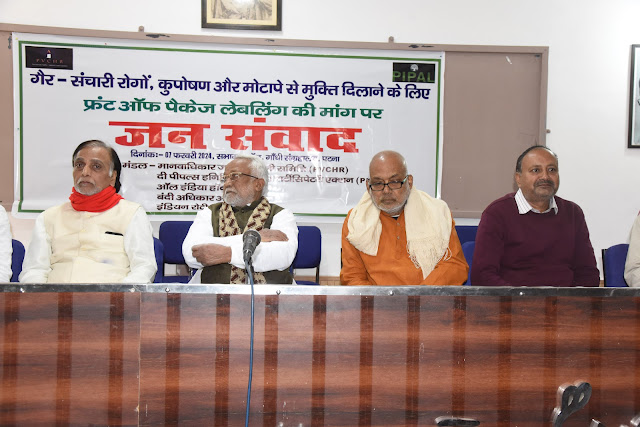
The meeting released findings from research conducted in Uttar Pradesh and Bihar demonstrating increasing consumption of ultra-processed foods among rural poor and marginalised households.
This strategy transformed scientific evidence into legislative dialogue.
Multi-Party Consensus
One notable characteristic of the campaign was its non-partisan nature.
PVCHR subsequently met Members of Parliament representing multiple political parties, ministers, parliamentary committee members, and political leaders to sustain momentum around Front-of-Pack Nutrition Labelling.
The objective was not political advocacy but evidence-informed public health reform.
These engagements helped ensure that the issue remained alive within parliamentary deliberations over an extended period.
Link: https://healthofchidren.blogspot.com/2022/09/dr-anil-agrawal-member-of-parliament.html
https://healthofchidren.blogspot.com/2023/04/meeting-held-with-members-of-parliament.html
https://healthofchidren.blogspot.com/2023/04/meeting-and-communicating-with-members.html
https://healthofchidren.blogspot.com/2022/10/response-received-from-rajya-sabha-on.html
Recent Policy Developments
Recent newspaper reports indicate that Parliament has recommended stronger regulation requiring disclosure of sugar content in packaged foods and stricter norms governing sugar levels in infant foods.
These developments represent an important step towards:
- increasing consumer awareness;
- protecting children's nutrition;
- strengthening preventive public health;
- improving transparency within India's food regulatory framework.
While these policy developments cannot be attributed to any single organisation, they demonstrate the cumulative impact of sustained engagement by parliamentarians, regulators, researchers, consumer groups, medical professionals, and civil society organisations.
Human Rights and Preventive Public Health
PVCHR's intervention reflects an evolving understanding of human rights.
Traditionally, human rights institutions have focused on responding to violations after harm has occurred.
However, preventing disease through informed consumer choice and healthier food environments represents an equally important dimension of the Right to Health.
Transparent nutrition labelling enables individuals to make informed dietary decisions while simultaneously encouraging manufacturers to improve product composition.
Thus, food labelling becomes not merely a regulatory instrument but a mechanism for protecting human dignity.
The correspondence received from the Rajya Sabha Secretariat provides documentary evidence that civil society submissions were formally considered within India's parliamentary system and transmitted to the Ministry of Health and Family Welfare for examination.
Recent policy attention to sugar disclosure and infant nutrition demonstrates that preventive public health has gained increasing prominence within India's regulatory agenda.
PVCHR's experience illustrates that sustained advocacy grounded in research, constitutional values, and parliamentary engagement can contribute meaningfully to national policy debates. Although policy reform is inherently collaborative and shaped by multiple stakeholders, this case demonstrates how human rights organisations can successfully bridge grassroots concerns and legislative institutions in pursuit of healthier and more equitable public policy.
The protection of children's health begins not in hospitals, but in public policy. Transparent food labelling is therefore not only a consumer protection measure—it is an expression of the constitutional commitment to the Right to Health.



Comments
Post a Comment